maat
MA'AT:
Multilingual Archive for Academic Topology
A computational observatory of global higher education discourse
Abstract
MA’AT is a multilingual information system that observes how higher education is discussed across global media, policy documents, and institutional sources. It aggregates RSS feeds from diverse linguistic ecosystems and transforms them into a structured dataset using semantic filtering and language-agnostic embeddings.
The system aims to map recurring patterns in how universities, governance structures, and academic systems are evolving across the world.
System Overview
MA’AT operates as a continuous ingestion pipeline:
- RSS feeds from global academic, policy, and journalistic sources
- multilingual embedding model for semantic comparison
- relevance filtering against a curated conceptual space
- language detection and optional translation
- deduplication and structured storage
Each article is evaluated not by keywords, but by semantic proximity to higher education-related concepts.
Dominant Themes
| Category | Article Count | Lead Article |
|---|---|---|
| Higher Education Crisis | 199 | Il curriculum dello studente e la Maturità-Talent Show di Valditara |
| University Administration | 142 | Students, alumni sue to block Kentucky State University overhaul |
| Teaching And Learning | 129 | Zwischen Bildung, Kompetenz und Effizienz – Hochschulbildung und ihre versteckten Logiken |
| Student Experience | 75 | 'Huge relief' as students given loans 'in error' get repayment reprieve |
| Research Activities | 63 | Doping accademico e fabbriche di revisioni pilotate |
| Politics | 37 | A lawsuit against a Black Lives Matter activist could chill all of our speech |
| Academic Abuse | 35 | What UCLA doesn’t want you to know |
| Education Cost | 30 | Hotărâre de Guvern privind stabilirea cifrei de școlarizare pentru învățământul preuniversitar și superior (2026 - 2027) |
| Funding Flows | 25 | Hotărâre de Guvern privind stabilirea cifrei de școlarizare pentru învățământul preuniversitar și superior |
| Science Society | 23 | Tre libri sull’università (e l’orizzonte che non si vede) |
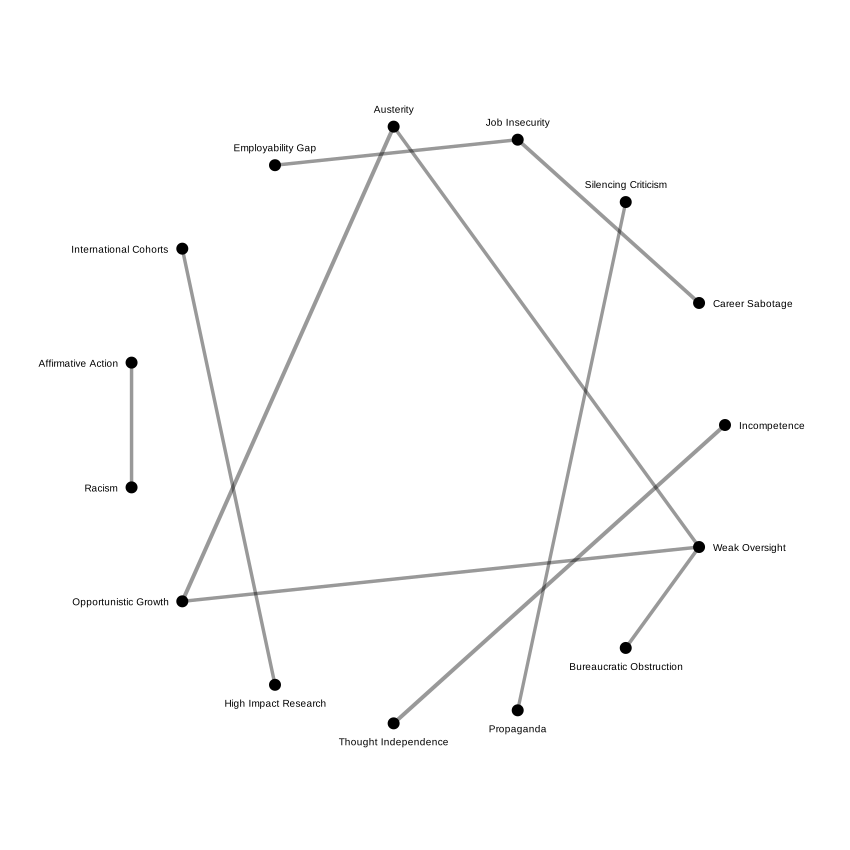
Strongest Topic Connections
System Status
- Total stored articles: 63
- Last run: 2026-05-17
Limitations
MA’AT depends on RSS availability and successful article extraction. Paywalled content, incomplete feeds, and extraction failures reduce coverage. Semantic filtering also introduces bias toward conceptually explicit texts, potentially underrepresenting implicit or emergent discourse.
Future Directions
- longitudinal mapping of policy narratives
- cross-country discourse comparison
- institutional actor tracking
- temporal evolution of semantic clusters
- visualisation of global higher education “attention fields”